AI for non-profits: the practical guide for 2026
Alexandre Talon
Inpactum editorial team
5 min read
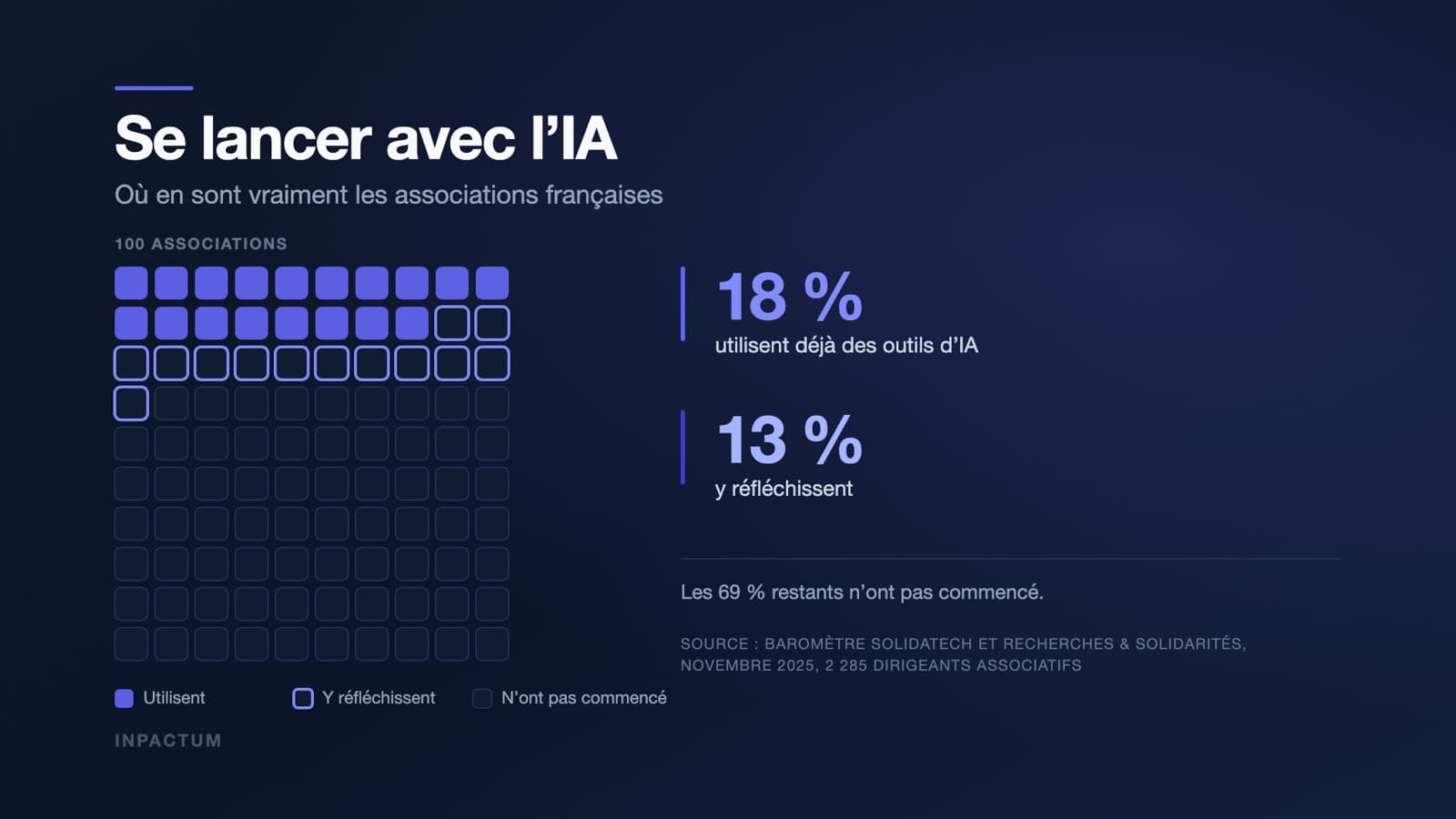
One French non-profit in five already uses artificial intelligence, according to the barometer published in November 2025 by Solidatech and Recherches & Solidarités, based on 2,285 leaders of associations. Among the sector's staff, use is far more widespread: in France générosités' June 2026 study, 86% of the professionals surveyed use it in their work, and 47% do so without any framework set by their organisation.
So AI is already inside your organisation, whether or not your board decided it. What remains are the practical questions: for which tasks, with which tool, at what price, and within which limits.
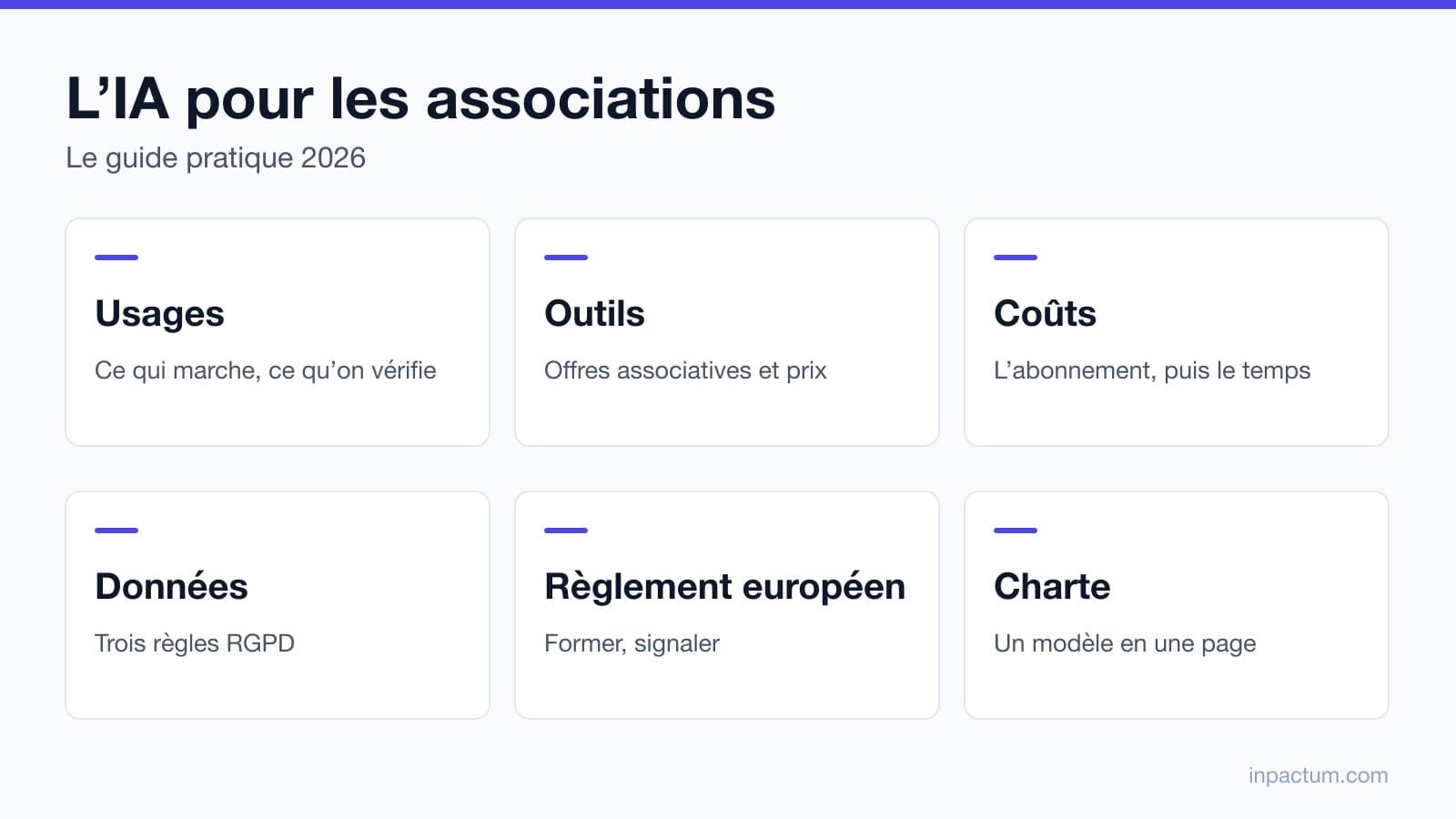
This guide answers them on a single page. Each section points to a more detailed article where the subject calls for it.
What AI does well, and what it does badly
An assistant such as ChatGPT, Claude, Gemini or Mistral's produces plausible text from what you give it. It is reliable at transforming material you provide: summarising, rewording, translating, structuring. It is much less reliable at producing information from memory, such as a figure, a point of law or the conditions of a call for proposals. It then gets things wrong with confidence, and without warning.
That distinction is enough to sort most of what a non-profit might use it for.
| Area | What works | What needs checking | What to avoid |
|---|---|---|---|
| Communications | Adapting one text for the website, the newsletter and social media; translating; proofreading | Figures and dates in generated text | Publishing a realistic generated image without saying so |
| Governance and member life | Minutes from notes or a transcript; agendas; notices of meeting | The record of decisions from a general assembly | Pasting your membership list into a consumer tool |
| Fundraising | Adapting an existing application to a new call; rewording a project for another funder | The funder's eligibility criteria | Submitting an application without reading every sentence |
| Serving the public | Drafting standard answers to frequent questions | An FAQ built from your own documents | Letting a tool answer a person in difficulty on its own |
| Data | Cleaning a spreadsheet, writing a formula, summarising open answers to a survey | Statistical analysis of a questionnaire | Handing a tool a decision about a person |
To get started step by step, beginning with a task that costs you time, running a pilot with a few volunteers and deciding after six to eight weeks, read Getting started with AI as an impact-driven organisation.
Which tool to choose
For everyday non-profit use, the main assistants are roughly equivalent. Three criteria help you choose.
The tools you already use. An organisation on Google Workspace gets Gemini in Google's free non-profit offer. An organisation on Microsoft 365 will look first at Copilot and Microsoft's discounts. An assistant that reads your documents where they already live will save you more time than a stronger model you have to feed by hand.
What happens to your data. Depending on their settings, free consumer versions may use your conversations to improve their models. Team plans generally exclude this by default. Check the provider's terms before uploading a single internal document.
The price per person. Two American providers have introduced non-profit pricing, alongside Google's free offer.
| Tool | Non-profit offer | Price as of September 2026 | Good to know |
|---|---|---|---|
| Gemini (Google) | Included in Google Workspace for Nonprofits | Free | NotebookLM is included too |
| ChatGPT (OpenAI) | OpenAI for Nonprofits, Business plan | $8 per person per month billed annually, $10 monthly | Eligibility checked by Goodstack |
| Claude (Anthropic) | Claude for Nonprofits, Team plan | $8 per person per month, two seats minimum | Eligibility checked by Goodstack |
| Copilot (Microsoft) | Non-profit discounts on Microsoft 365 | Depends on the licence | Free AI training alongside |
| Mistral's assistant | No non-profit offer found | Limited free version, Pro at €14.99 per month, Team at €24.99 per person per month | French provider |
One caveat on the OpenAI and Anthropic offers: they were designed for American charitable organisations, and their pages do not say clearly whether a French association (loi 1901) qualifies. Eligibility is checked through Goodstack, a service that verifies the status of non-profit organisations. Applying takes a few minutes, so the simplest thing is to try.
Do you need to pay? Not for a first trial. Free versions are enough to test a use case on documents that contain no personal data. A subscription makes sense once several people use the tool every week and you want to work on internal documents with it.
What about open source?
Many non-profits ask the question, out of consistency with their values or to keep control of their data. The term covers three things that do not take the same effort.
Open models. Several providers publish the weights of their models, which anyone can download and run. Mistral releases several under an open licence; Meta does the same with Llama, under its own more restrictive licence. Two services let you use them without running a server:
- Hugging Face, a platform founded by French entrepreneurs, is the reference library for open models, with more than a million published. Its Inference Endpoints service deploys the model of your choice on a dedicated server, with a European region (Ireland) available.
- OpenRouter gives access to several hundred models, open or not, with a single account and a single key. You can ask it to route requests only to providers that do not retain data; fully European processing, however, is reserved for its enterprise plans.
Self-hosted agents. Open source projects published on GitHub, such as OpenClaw or Hermes Agent by Nous Research, install an always-on assistant on your own server. You message it from Telegram, Slack or WhatsApp, it remembers past exchanges and can chain tasks together. Some hosting providers install them in one click: Hostinger does, a Lithuanian host that offers servers located in France, from $6.49 per month at the promotional rate for its smallest plan ($11.99 on renewal).
Referral link: Inpactum earns a commission if you subscribe through this link.
Two precautions before you start.
- Hosting the agent is not hosting the model. The agent passes your requests to a model, usually through a key with Anthropic, OpenAI or OpenRouter. Your text therefore leaves your server, unless you connect the agent to an open model hosted in Europe.
- Security becomes your job. An agent with access to a mailbox or to files is a way in. OpenClaw showed it in 2026: at the end of January, around 21,000 installations were exposed on the internet, 341 of the 2,857 extensions published on its marketplace turned out to be malicious, and several critical vulnerabilities had to be patched. Do not give it your organisation's mailbox or any beneficiary data without someone who knows how to secure a server.
Open source tools built for the sector. Data for Good, an entirely volunteer-run French association, publishes its projects as open source, including a tool that helps answer calls for proposals.
For a small non-profit, hosting a model or an agent usually costs more time than it saves, for results below those of commercial assistants. It makes sense for a specific project, with sensitive data or a need for longevity, carried out with a digital expert.
What it really costs
The subscription is rarely the main cost. For a small team of three, a non-profit plan at $8 comes to under $300 a year. AssoConnect, a larger organisation, ran its pilot with eight volunteers at €29 per person per month, a little over €230 a month during the test phase.
The real cost is time: learning to write a request, reviewing what comes out, building the habit in the team. Allow a few hours per person at the start, then a group check-in every two weeks during the pilot. Without someone who owns the subject, use drops off within a few weeks, whatever the tool.
Personal data: three rules
In 2025 the CNIL, France's data protection authority, set out how the GDPR applies to artificial intelligence systems. For a non-profit, three rules cover most situations.
- No personal data in a consumer tool. Names, contact details, social situation, the health of beneficiaries, members or donors: anonymise first, or use a plan that governs the processing by contract.
- Tell the people concerned when a service you offer them relies on AI.
- Keep a human decision on anything that affects a person: support, referral, an application.
Minors and health data carry the strictest requirements. Only work with them under a written framework and, where possible, with support from professionals in the field.
What the EU AI Act changes for you
The European regulation on artificial intelligence, known as the AI Act, does not only target companies that build models. A non-profit that uses an assistant is what the text calls a "deployer", and two obligations already apply to it.
Train the people who use it. Since 2 February 2025, Article 4 has required organisations that use AI systems to build the skills of the people who use them on their behalf, volunteers included. The text was relaxed by a so-called "omnibus" regulation that came into force on 27 July 2026: organisations must now take measures to promote this literacy, without having to guarantee a specific level. For a non-profit, a short briefing on the approved tools and their limits, tailored to actual use, and a written record of what was done amount to a proportionate approach.
Label certain generated content. Since 2 August 2026, Article 50 has required you to disclose:
- images, video or audio generated or altered by AI that could pass for authentic;
- generated text published to inform the public on matters of public interest, unless a person has reviewed its substance and takes responsibility for it. A spelling check does not count as review.
If you put a chatbot on your website, the people using it must know they are talking to a machine.
Uses classed as high risk. Screening job applications or deciding on access to essential social benefits are among the uses the regulation classes as high risk. Their detailed obligations have been postponed to December 2027. The rule of caution applies today: the tool prepares, a person decides.
Writing a one-page AI usage policy
An internal framework is the first thing the professionals surveyed by France générosités ask for: 75% put it ahead of training and resources. One page is enough to start. Here is a template to adapt, then have approved by your board.
AI usage policy of [name of the organisation]
- The approved tools are: [list]. Any other tool is discussed before use.
- No personal data about our beneficiaries, members, donors or volunteers is entered into an AI tool, except in [tool covered by a contract] and for [specific uses].
- Any text produced with AI is reviewed for substance by a person before it is sent or published. That person is responsible for it.
- Generated images, video and audio that could pass for real are labelled as such.
- No decision about a person is delegated to an AI tool.
- Anyone who starts using these tools for the organisation receives a short briefing on this policy. [First name Last name] is the point of contact.
- This policy is reviewed every six months.
To go further, the free guide "Encadrer l'usage de l'IA au sein des associations et fondations" (in French), published in March 2026 by France générosités and Don en Confiance, sets out the approach in three stages: identify uses, assess risks, organise governance.
Getting help, training and funding in France
In 2026 there is no public plan dedicated to AI in French non-profits: the "Osez l'IA" plan targets businesses only. What exists comes from non-profit organisations, foundations and programmes run by tech companies.
- To find your way: Guid'Asso, the national network of support points for associations, and the DLA (local support scheme) if your organisation employs at least one person.
- To get trained: IA for Good (Share it, Latitudes, Data for Good, Bayes Impact), Cafés IA, and the Semaine de l'IA pour tous.
- To deliver a project: Share it, Latitudes and Data for Good, free of charge, provided you come with a clear need and a person who is available.
- To fund it: the FDVA "fonctionnement-innovation" grant, whose 2027 round will probably open between late February and March, and calls for proposals from foundations.
Each scheme is described, with its audience, what it provides and its cost, in Digital and AI: the schemes that truly support non-profits in 2026.
They have done it
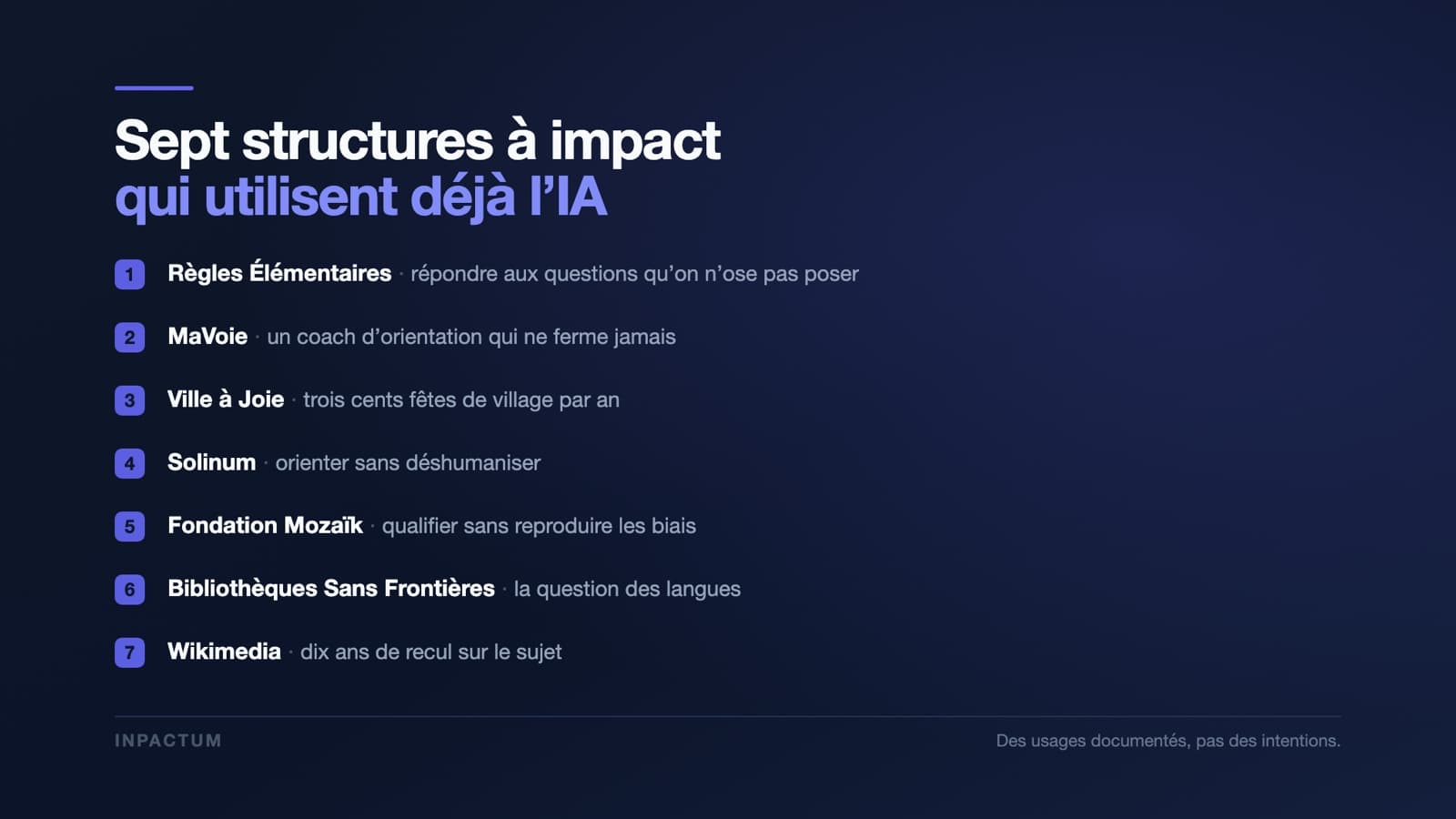
The organisations that get real value from AI all started with a problem, never with a tool. Ville à Joie, which runs some three hundred village fêtes a year to help people claim the rights they are entitled to, uses it to draft emails to mayors and produce materials for each event. Solinum added a multilingual chat to Soliguide, with trained social workers behind it. Règles Élémentaires built its menstrual education chatbot with school nurses, teachers and pupils. All of them set down in writing what they refused to hand over to the machine.
Their stories, and those of four other organisations, are told in Seven impact-driven organisations already using AI.
Frequently asked questions
Can a non-profit use ChatGPT for free? Yes, the free version is open to everyone. It is not suitable for documents that contain personal data. For team use, the non-profit offers from Google, OpenAI and Anthropic range from free to $8 per person per month.
Do we need to notify the CNIL that we use AI? No, there is no notification to make. If the tool processes personal data, that processing is documented like any other under the GDPR, and the people concerned must be informed.
Can we write a grant application with AI? Yes, it is one of the most common uses. AI helps adapt an existing application to a new call and fit a required format. It does not know the funder's current criteria: check them at the source, and review every figure.
Do volunteers need training? Those who use AI for the organisation, yes. The EU regulation covers everyone who uses it on the organisation's behalf, whether paid or not. An hour on the usage policy and the limits of the tools is a good start.
And Inpactum?
Inpactum brings together impact organisations, digital experts and advisors. If your organisation wants to go beyond an assistant and needs help with a project, start with the digital self-assessment, free and with no account needed, then describe your need from the impact organisations page to meet committed experts.
Sources
- Solidatech and Recherches & Solidarités, La place du numérique dans le projet associatif en 2025, November 2025
- France générosités, L'usage de l'IA au sein des OSBL, volet 1, June 2026
- France générosités and Don en Confiance, Encadrer l'usage de l'IA au sein des associations et fondations, March 2026
- Google, Workspace for Nonprofits and AI
- OpenAI for Nonprofits, via Goodstack
- Claude for Nonprofits, getting started
- Mistral, pricing
- Microsoft, non-profit sector, April 2026
- Regulation (EU) 2024/1689 on artificial intelligence, Article 4 and Article 50
- European Commission, FAQ on the transparency obligations of Article 50
- Journal du Net, Article 4 de l'AI Act réécrit, September 2026
- CNIL, recommendations on applying the GDPR to AI systems, 2025
- Hugging Face, Inference Endpoints
- OpenRouter, zero data retention and EU routing
- OpenClaw, installing on Hostinger and Hermes Agent, GitHub repository
- Hostinger, OpenClaw offer and server locations
- Stormshield, OpenClaw : risques et rétrospectives, May 2026, updated July 2026
Topics
- Intelligence artificielle
Read next
AI for Good: what the term really covers
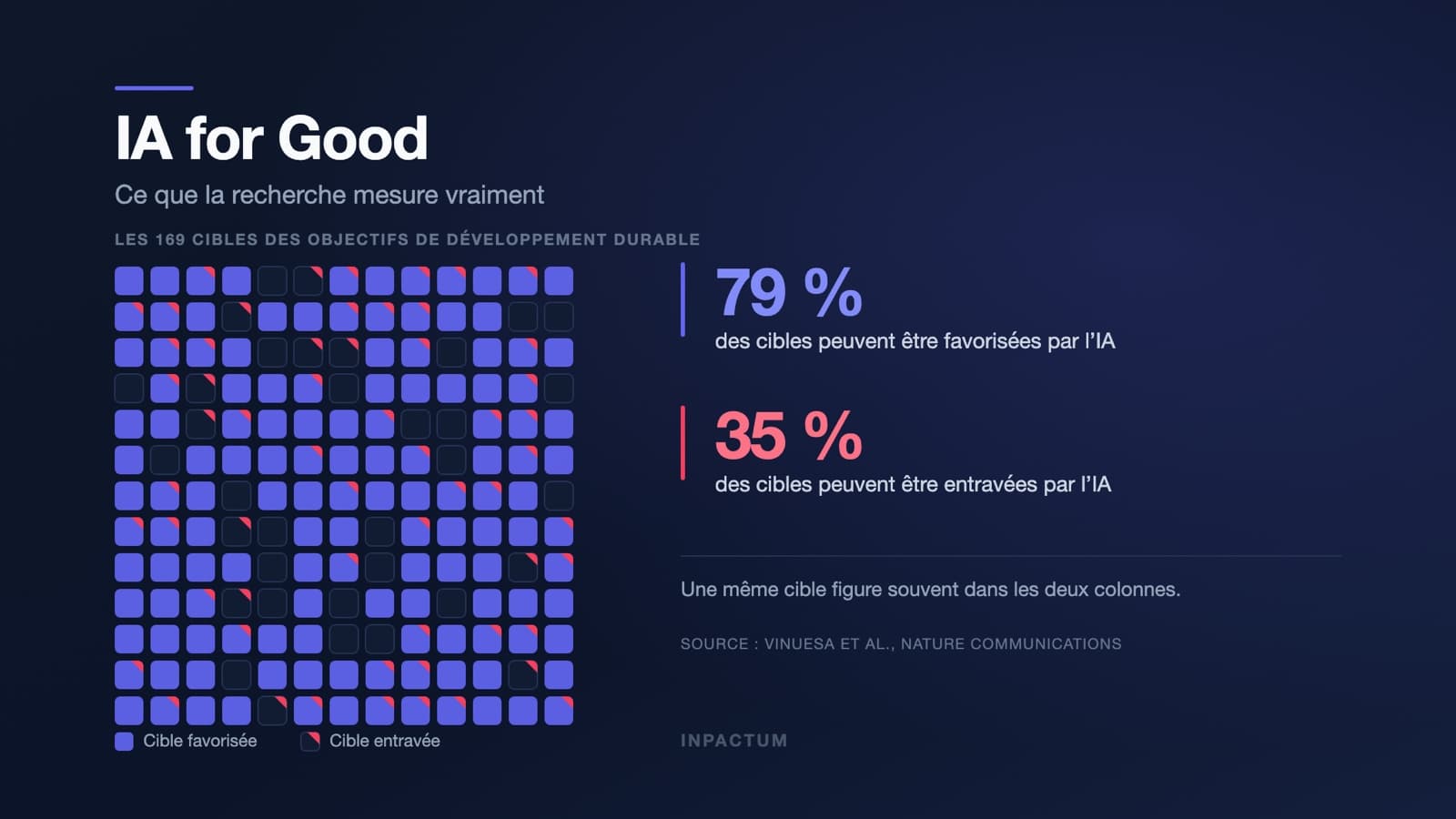
AI for Good: where the term comes from, what research measures (79% of SDG targets advanced, 35% hindered) and 4 questions to assess a project.
Getting started with AI as an impact-driven organisation
Where to begin, what budget, which data never to share and when to stop: a step-by-step method drawn from documented non-profit experiences.
Seven impact-driven organisations already using AI
Règles Élémentaires, MaVoie, Solinum, Mozaïk, BSF, Wikimedia: seven documented uses of AI in impact-driven organisations, and what they teach.