Digital and AI: the schemes that truly support non-profits in 2026
Alexandre Talon
Inpactum editorial team
11 min read
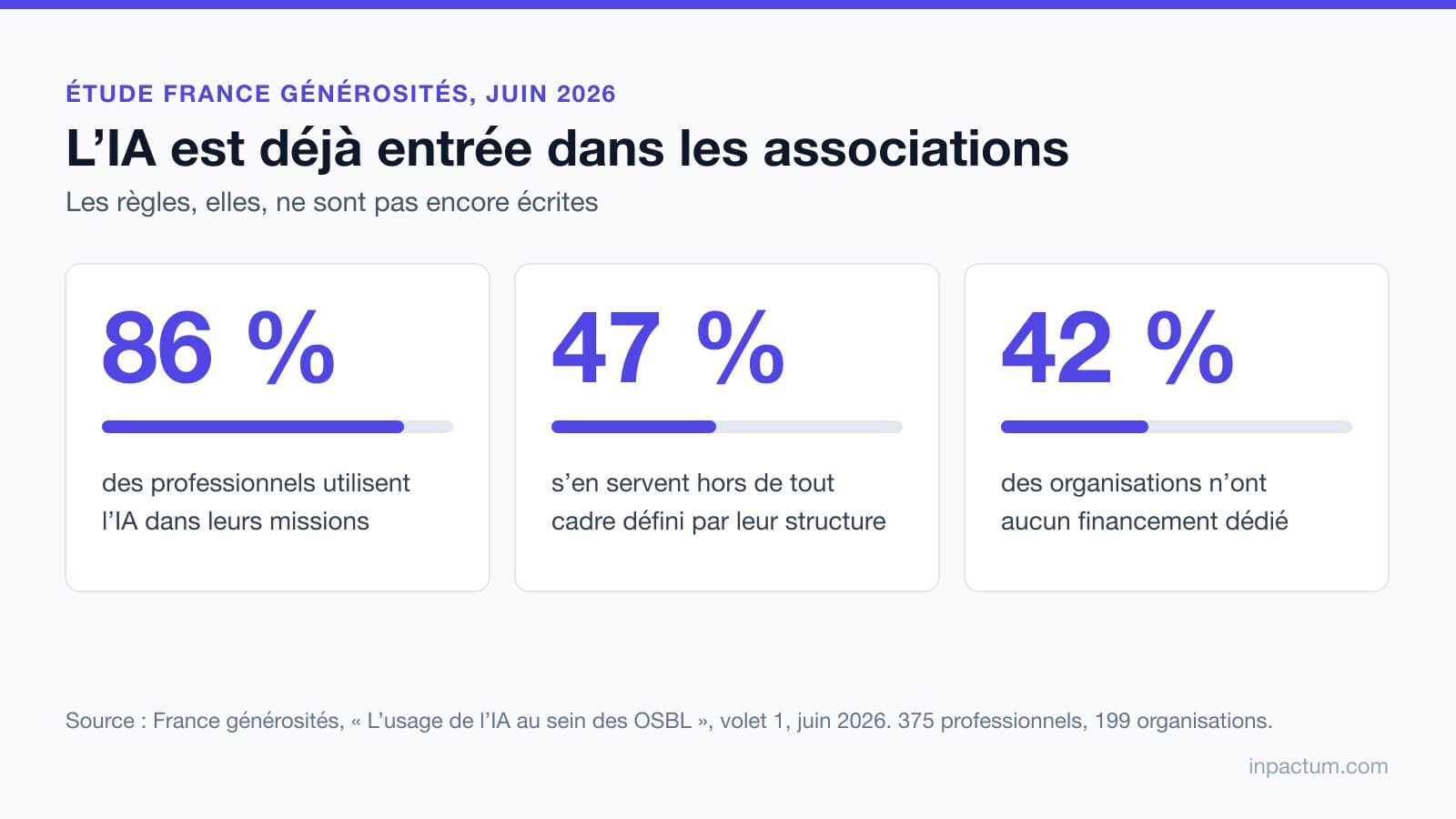
One in five non-profits was already using artificial intelligence in spring 2025. This is the figure from the Solidatech and Recherches & Solidarités barometer, based on a survey of 2,285 leaders. A year later, France générosités surveyed 375 professionals from non-profit organisations and obtained another figure: 86% of them use AI in their missions, and 47% do so outside any framework defined by their organisation.
Uses are advancing faster than support. A non-profit seeking help encounters a fragmented landscape: public schemes, foundations, digital companies’ programmes, volunteer networks. Each scheme sets its own entry conditions, and they are hard to compare.
Here is what exists as of September 2026, sorted by need, with the target audience, contribution and cost for each scheme. Cooperatives, social enterprises and companies approved as ESUS (Entreprise Solidaire d’Utilité Sociale) follow different rules: they have their own section at the end of the article.
These two studies do not measure the same thing, which explains the gap. The 18% from the Solidatech barometer covers non-profits as a whole, of all sizes. The 86% from France générosités covers individual use by the professionals surveyed.
What is holding non-profits back
The Solidatech 2025 barometer ranks human barriers as the main obstacle (44%), ahead of technical (33%), financial (24%) and strategic (21%) barriers. Only 24% of boards of directors are involved in digital issues.
Regarding AI in particular, the study published on 9 June 2026 by France générosités, conducted from February to April among 375 professionals and 199 organisations, provides further insight:
- 58% of respondents find the tools difficult to understand or implement;
- 53% point to a lack of digital culture within their governance;
- 42% of organisations report a lack of dedicated funding;
- 75% are primarily waiting for an internal framework to be put in place.
The problem is therefore almost never the tool itself. It is the skills to use it, and the time to get started.
1. Get guidance and conduct a diagnostic
Guid’Asso. The local welcome network run by the ministry responsible for associative life and Le Mouvement associatif. Over 2,000 labelled support points, 140,000 non-profits supported in 2025. It does not specifically address AI, but it is the right first port of call when you do not know who to turn to. Free.
The DLA (Dispositif local d’accompagnement – Local Support Scheme). It funds consultant interventions for social and solidarity economy (ESS) organisations that employ staff: a diagnostic, followed by support on a specific topic. Digital is included (management tools, communication, GDPR, and now AI). As early as 2019, 15% of DLA support focused on digital. Free for the non-profit. Limitation: at least one employee is required, which excludes the vast majority of French non-profits, since nine out of ten have none.
Solidatech’s digital self-diagnostic. An online questionnaire, free of charge, to assess your organisation and identify its priorities.
2. Equip yourself without breaking the bank
Solidatech. The programme run by Les Ateliers du Bocage (Emmaüs) is the sector’s benchmark: discounted software, refurbished hardware, paid training and consulting, free webinars. 45,000 registered organisations. Registration is free and open to non-profits, public utility foundations and endowment funds.
Google for Nonprofits. Workspace for Nonprofits is free and now includes Gemini and NotebookLM. Google Ad Grants offers up to $10,000 in advertising per month.
Microsoft. Discounts on licences, and a training component: the "AI for Nonprofits" certification (Elevate programme, with LinkedIn and NetHope) and IAgenGo, a free training programme developed with Simplon and launched in November 2025.
Salesforce. The Power of Us programme provides licences for its customer relationship management software to non-profits.
Bear in mind: a free licence still needs to be configured, maintained, and above all adopted by the team. Its cost says nothing about the time that will need to be devoted to it.
3. Train and understand AI
IA for Good. Run by Share it and Latitudes, with Data for Good and Bayes Impact, and supported by several corporate foundations. On the agenda: awareness-raising webinars, the "IA Battle" workshop, practical training and methodological sheets, including on funding applications.
Café IA. Free citizen exchange sessions on AI, run locally by volunteer organisations, many of which are non-profits. Launched in 2024 by the Conseil national du numérique. The format has spread: the "Cafés IAssos", run by SAW-B with FARI and the Social Good Accelerator with Erasmus+ funding, brought together in spring 2026 organisations from social action, popular education and social inclusion. The sessions are now closed, and the capitalisation is still to be announced.
AI for All Week. First edition in May 2026, run by La MedNum and the Make.org Foundation: 1,178 events organised by 600 organisations. The 2027 edition will be an opportunity to organise a workshop for your volunteers, or simply to see what others are doing.
Le Mouvement associatif. Several regional branches offer webinars on "AI: uses and vigilance". Check with your region.
The Social Good Accelerator. This is not a scheme you can apply to, and it is best to know this before knocking on its door. It is a European network for the digital social and solidarity economy, which produces open-access resources: the Digital ESS Observatory, a sector typology and an analysis of the 2026 digital barometer for ESS organisations. It also organises NEC ESS Europe every autumn, with Crédit Coopératif, Emmaüs Connect and Fondation de France. Its training programmes are run through European projects with limited durations, all of which ended in 2026. Membership, whose fee is calculated on a case-by-case basis, mainly provides monitoring of European funding and a place in future consortia.
ANCT digital advisors. They mainly support the general public, but can help small non-profits with the basics, and 1,800 of them have been trained in AI. One caveat: the scheme’s budget is falling from €40 million in 2025 to €14 million in 2026, according to the Senate. The offer will be reduced.
4. Have a project carried out by volunteers or patrons
Share it. Tech teams provided through skills-based patronage, from a one-day insight to a six- to twelve-month project. Free for the support, but the non-profit then pays for hosting and licences. Conditions: at least two permanent employees and a referent available three to four days a week. The requirement may be off-putting, but it is what prevents projects from being abandoned halfway through. Share it also runs the "Numérique & Aidants" programme with Latitudes, free for non-profits that support carers.
Latitudes. Students carry out free tech projects for non-profits as part of Tech for Good Explorers. The organisation also runs Cyber for Good Academy on cybersecurity.
Data for Good. A fully volunteer and open-source non-profit. Twice a year, its members carry out data and AI projects for general interest organisations. Over 140 organisations supported. It has notably developed an open-source tool to help respond to calls for projects. Free.
Passerelles & Compétences. A skills-based volunteering network, which also covers digital missions.
5. Fund your transition
The FDVA "fonctionnement-innovation" (operating-innovation). The state grant for small and medium-sized non-profits, often between €1,000 and €15,000 depending on the department. Some departments make digital transition a priority. The 2026 campaign is closed: prepare for 2027, which generally opens between late February and March.
Foundations. The "Numérique solidaire" call for projects from Fondation SFR is open until 16 October 2026. Other foundations (Orange, Afnic, Fondation de France) regularly launch digital-related calls for projects: the calendars change every year, so check directly on their websites.
6. Frame uses
When 47% of professionals use AI outside any framework, the priority is not to add tools but to set rules. This is indeed the first expectation expressed in the France générosités study, ahead of training and resources. The free guide published in March 2026 with Don en Confiance, "Encadrer l’usage de l’IA au sein des associations et fondations" (Framing AI use within non-profits and foundations), is a good starting point for writing your own charter: which data never leaves the organisation, and who reviews what the AI produces before publication. A second part of the study, focusing on ethics and transparency, is announced for early October 2026.
What is still missing
The "Osez l’IA" (Dare AI) plan, with a budget of €200 million, is only aimed at businesses, and its one-year review does not mention non-profits or the ESS. Its main tool, the Diag Data IA operated by Bpifrance, is reserved for SMEs and mid-cap companies with 10 to 2,000 employees registered in the trade register: a non-profit is excluded by its very status. We have not identified any public plan dedicated to non-profits and AI for 2025-2026.
At the same time, funding for digital advisors is falling by two-thirds. Most of the current offer therefore relies on non-profit actors, foundations and digital companies’ programmes. It is precisely to structure this ecosystem that the Alliance Numérique & IA pour les associations was created in September 2025, coordinated by Share it.
And what about other ESS organisations?
This guide focuses on non-profits, because that is where the gap is most glaring. A cooperative (SCOP, SCIC, employee and activity cooperative), a social enterprise or a company approved as ESUS is in a different, and sometimes more comfortable, situation.
First, the DLA does not reserve its support to non-profits: SCOPs, SCICs, social inclusion organisations, ESATs, adapted companies and companies approved as ESUS are eligible as long as they employ staff. And it already covers AI, since a collective DLA in Hauts-de-France is offering a five-day module on generative AI in 2026, fully funded. On the Tech for Good side, Share it, Latitudes, IA for Good and Cyber for Good ESS explicitly target cooperatives and social enterprises, free of charge.
Other doors are closed, however. Solidatech reserves its catalogue for declared non-profits, public utility foundations and endowment funds, and Google, Microsoft and Salesforce programmes require non-profit status. Data for Good, for its part, requires a non-profit, non-lucrative general interest organisation, without clarifying the case of a SCOP: it is best to ask the non-profit directly.
Then there is the "Osez l’IA" plan, open in theory but closed in practice. A cooperative is a company registered in the trade register, so nothing excludes it in principle. But the Diag Data IA requires at least 10 employees and costs €10,000 excluding VAT, 40% of which is covered, i.e. around €6,000 to pay. AI accelerators require more than €8 million in turnover and more than 50 employees. These thresholds exclude most cooperatives in practice.
As for networks, they raise awareness more than they provide support. The CG Scop dedicated its July 2026 convention to AI, the Fédération des entreprises d’insertion offers introductory sessions to its members, and Coorace opened the debate at its general assembly. These are opportunities for exchange, not support schemes. Regional aid, meanwhile, is very uneven: Guadeloupe funds up to 70% of ESS organisations’ expenses, including cooperatives, up to €56,000, while other regions have nothing comparable.
Finally, a word on the figures: no survey measures digital and AI use in cooperatives and social inclusion organisations. The 18% mentioned earlier applies to non-profits, and to non-profits alone.
Where to start
Small non-profit with no employees. Start with a self-diagnostic, then register with Solidatech and activate the free offers from Google or Microsoft. To understand AI without pressure, a Café IA near you or an IA for Good webinar is enough.
Non-profit with employees. Apply to your department’s DLA for funded support. Set an AI usage framework using the France générosités guide before deploying anything.
A specific project in mind. Share it, Latitudes and Data for Good can carry it out with you. Prepare a clear need and designate an available person: this is the success condition that all these programmes highlight.
Looking for funding. Prepare for FDVA 2027 as early as winter and monitor foundation calls, particularly the one from Fondation SFR until 16 October.
And Inpactum in all this?
Let’s be frank: Inpactum sells services in the field described by this guide. Here is what we offer; it is up to you to decide whether it complements the schemes above.
- A free self-diagnostic, built from the work of the Alliance Numérique & IA pour les associations: 18 questions on five dimensions (management, tools, skills, continuity, AI), no account creation required, with shareable results for a funder. Available at inpactum.com/diagnostic.
- Publishing a need when you are looking for a service provider or expert on a specific topic.
- A directory of impact organisations, experts and support providers.
- Les Échanges, to ask a question to other organisations that have been through it.
The diagnostic is accessible without creating anything. The other three require an account, which is also free.
Do you know of a scheme missing from this guide? Report it in Les Échanges, and we will update it.
Summary
| Scheme | For whom | Contribution | Cost |
|---|---|---|---|
| Guid’Asso | All non-profits | Guidance, information | Free |
| DLA | ESS organisations with employees | Diagnostic and support by consultants | Free |
| Solidatech | Non-profits, foundations, endowment funds | Discounted software, hardware, training, self-diagnostic | Free registration, variable services |
| Google for Nonprofits | Eligible non-profits | Workspace with Gemini, Ad Grants | Free |
| Microsoft | Eligible non-profits | Discounted licences, AI training | Discounts, free training |
| IA for Good | ESS organisations | Awareness-raising, training, practical sheets | Not displayed |
| Café IA | General public, run by local organisations | AI exchange sessions | Free |
| Share it | Organisations with at least 2 employees | Tech projects through skills-based patronage | Free, hosting and licences at organisation’s expense |
| Latitudes | Non-profits | Projects carried out by students | Free |
| Data for Good | Non-profit, non-lucrative general interest organisations | Volunteer data and AI projects | Free |
| Cyber for Good ESS | Non-profits, cooperatives, social enterprises | Cybersecurity webinars and self-diagnostic | Free |
| FDVA 2 | Small and medium-sized non-profits | Operating or innovation grant | Grant |
| France générosités guide | Non-profits and foundations | AI usage framework | Free |
| Social Good Accelerator | Digital ESS actors | Observatory, resources, annual event | Free resources, paid membership |
Sources
- Recherches & Solidarités, La France associative, October 2025
- Solidatech and Recherches & Solidarités, La place du numérique dans le projet associatif en 2025, November 2025
- France générosités, L’usage de l’IA au sein des OSBL, volet 1, 9 June 2026
- Guid’Asso en chiffres 2025
- Avise, chiffres clés du DLA 2019
- Solidatech, the programme and self-diagnostic
- Google, Workspace for Nonprofits and AI and Google Ad Grants
- Microsoft, non-profit sector, April 2026
- IA for Good
- Café IA and Cafés IAssos
- Social Good Accelerator, Observatoire de l’ESS numérique and décryptage du baromètre du numérique 2026, February 2026
- Paroles d’élus, bilan de la Semaine de l’IA pour tous
- Sénat, avis sur le projet de loi de finances 2026
- Share it, support
- Latitudes
- Data for Good
- FDVA fonctionnement-innovation 2026
- Régions de France, appel à projets Numérique solidaire de la Fondation SFR
- France générosités and Don en Confiance, Encadrer l’usage de l’IA, March 2026
- Ministère de l’Économie, bilan à un an du plan Osez l’IA, September 2026, and renforcement du plan, June 2026
- France Num, associations
- Info DLA, beneficiaries of the scheme and DLA Grand Est
- Le Mouvement associatif Hauts-de-France, accompagnements collectifs DLA 2026
- Solidatech, FAQ on eligibility
- Latitudes, ESS offer and Cyber for Good ESS
- Data for Good, propose a project
- Région Guadeloupe, aide régionale aux structures de l’ESS
- Alliance Numérique & IA pour les associations
Topics
- Transformation numérique