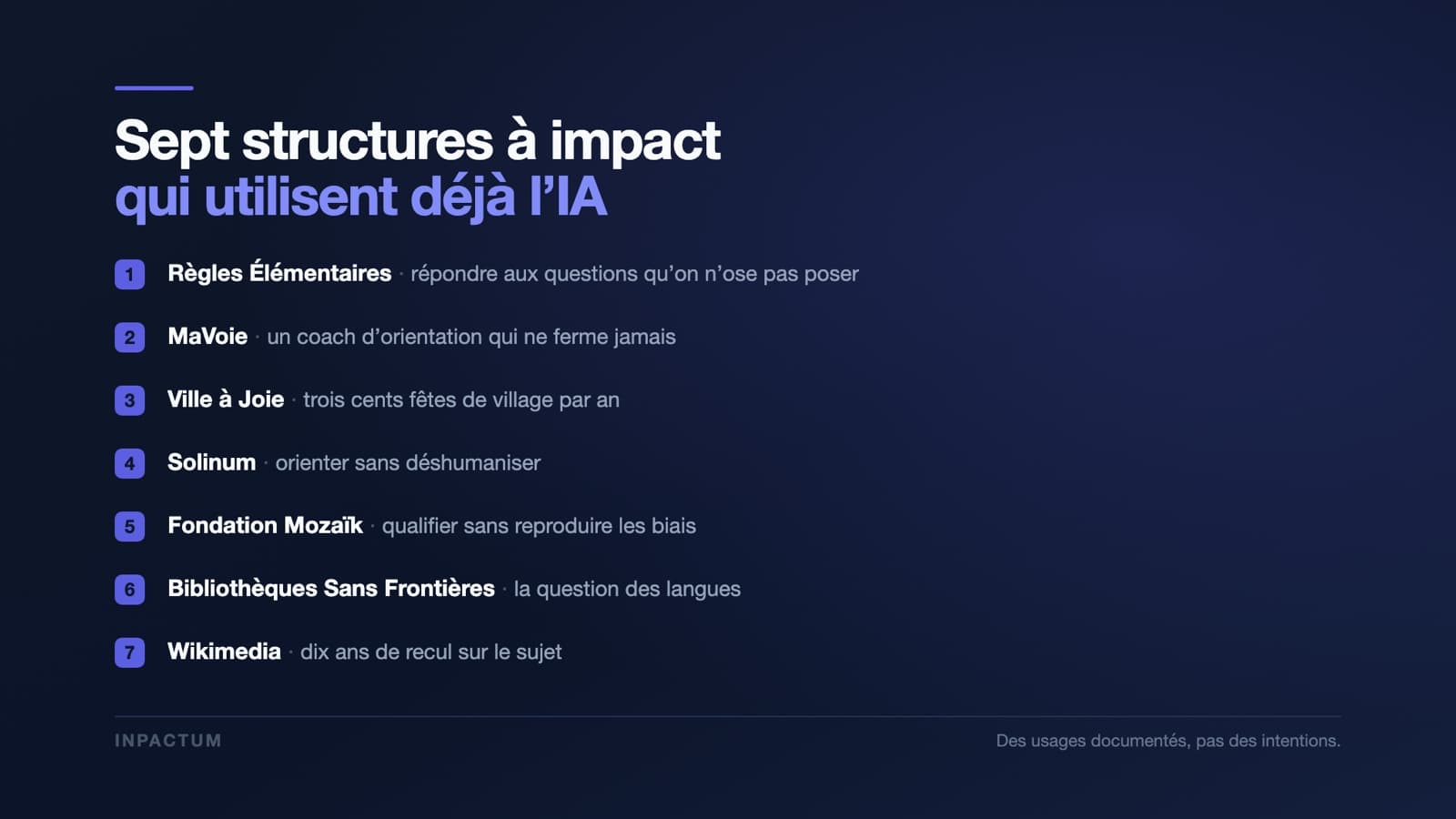
Seven impact-driven organisations already using AI
Alexandre Talon
Inpactum editorial team
5 min read
Eighteen per cent of French associations already use artificial intelligence tools, and thirteen per cent are considering it. This is revealed by the fifth edition of the Solidatech and Recherches & Solidarités barometer, published in November 2025 based on a survey of 2,285 association leaders. Behind these percentages lie very concrete uses, rarely spectacular, often born out of resource constraints.
We have reviewed seven documented projects from French and international impact-driven organisations. None deployed AI for show. All did so to handle a workload they could no longer manage, and all set explicit limits on what they were willing to entrust to it.
What these seven cases have in common
Three things recur from one project to the next.
First, AI comes after the problem, never before. No one in this list started by asking, "What could we do with AI?" All began with an identified pain point: too many emails to write, too many services to reference, too many questions to answer, too many applications to qualify.
Second, none replaced a human. In all seven cases, the tool handles the repetitive part and frees up time for support. This is explicit at Solinum and MaVoie, and is even a condition set by several teams before accepting the project.
Finally, the issue of data is addressed upfront, not after the fact. When the audience is minors or in vulnerable situations, the organisations mentioned here made their decisions before deployment, not at the first incident.
Règles Élémentaires: answering questions people dare not ask
The association Règles Élémentaires, which fights against period poverty, launched on 11 October 2024, International Day of the Girl, an menstrual education platform called Parlons Règles. It targets 8-14-year-olds.
The platform offers educational videos, a FAQ, a space for parents, animation resources for teachers and perischool staff, and a conversational agent named Timi. The platform was built with students from sixth to ninth grade, teachers, school nurses and parents, in partnership with Bayes Impact, an organisation specialising in social impact digital projects.
The value of the conversational agent lies in a simple observation: teenagers find it easier to ask an embarrassing question to a machine than to an adult. Anonymity removes inhibition. The downside is just as simple: on health topics, an approximate answer is a problem, and the target audience lacks the means to correct it. This is precisely why the system was co-built with school health professionals rather than connected to a generalist model.
MaVoie: an orientation coach that never closes
MaVoie is an association created in 2020 by Article 1, Chance and Generation France, three professional integration organisations. Its target audience: young people who are neither in employment, education, nor training. Since its creation, it claims to have supported over 26,000 young people into employment, nearly 60% of whom have a high school diploma or less.
In June 2025, it launched Liv.ia, a free app that combines human support with a conversational coach, featuring an interactive journey and daily challenges. The association takes a clear stance: not opposing artificial intelligence to human listening, but making both work together.
The logic is one of availability. An advisor is available by appointment, during office hours. A young person in a difficult situation rarely seeks help at those times. The tool fills the gap, provides guidance, and flags situations that require human intervention.
Ville à Joie: three hundred village festivals a year
Ville à Joie is a social and solidarity economy (ESS) company tackling non-take-up of rights in rural areas. Its method is physical before it is digital: it organises around three hundred travelling festivals a year in villages of fewer than 1,000 inhabitants, to reach residents that service desks no longer do.
Three hundred events a year means three hundred mayors to convince, three hundred posters to produce, three hundred logistics files. Its founder, Marius Drigny, used generative AI precisely for this: writing personalised emails to elected officials by consolidating useful information for each municipality, and producing communication materials tailored to each event. The team also built an Airtable-based app that centralises around twenty essential services, with an assistant to help staff respond to residents.
This is the most instructive case for a small organisation, because it requires no specific development. An online spreadsheet, a generalist model, and immediate time savings on the administrative side of a job that remains entirely human in the field.
Solinum: guiding without dehumanising
Solinum runs Soliguide, the platform that lists essential places and services for people in difficulty: food, health, accommodation, social support, mobility. The service is free, anonymous, and available in ten languages. It references over 98,000 solidarity services and recorded more than 3.7 million searches in 2024, a 95% increase compared to 2022.
Solinum’s starting point was a study it conducted itself in 2019, Précarité connectée: 71% of homeless people own a smartphone and 55% connect every day. The received idea that extreme poverty is disconnected from digital is unfounded.
What is noteworthy is the line the association takes on automation. Soliguide includes a multilingual chat, but with social workers trained in pre-social diagnosis behind it. The digital tool is presented as a vector for human connection, far from any dehumanising automation. For a vulnerable audience, this is a fundamental choice, not a communication precaution.
Fondation Mozaïk: qualifying without reproducing biases
Saïd Hammouche created Mozaïk RH in 2008, then Fondation Mozaïk in 2016, to connect recruiters with candidates from the least privileged areas. The foundation operates the DiversifiezVosTalents.com platform, whose algorithm focuses on actual skills rather than the usual social signals on a CV, and leads the #TechYourPlace movement.
It has developed ZIA, an artificial intelligence solution designed to qualify and structure a pool of talents ready to enter employment, with support from Accenture and Microsoft.
This is the case where vigilance is highest, for a mechanical reason: a model trained on past recruitments learns past discriminations. A tool intended to correct a bias can create a new one, harder to detect because it appears objective. The answer lies in three points that any organisation automating selection should adopt: knowing what data the model was built on, keeping the final decision with a human, and being able to explain a rejection.
Bibliothèques Sans Frontières: the language issue
Bibliothèques Sans Frontières is known for the Ideas Box, the kit library designed with designer Philippe Starck and the United Nations High Commissioner for Refugees, deployable quickly on almost any terrain. In Senegal, the association equipped seventy rural schools with Ideas Cube, very small servers that provide access to thousands of educational resources without a permanent connection.
Its annual report states a fact that few actors formulate as clearly: for populations living in low-infrastructure areas, large language models remain largely inaccessible and poorly represent global linguistic and cultural diversity. In other words, the wave supposed to democratise access to knowledge may first widen the gap. The association is nevertheless continuing with its Ideas AI initiative.
For an organisation working with allophone audiences in France, the lesson is directly transferable: the quality of a model drops sharply as soon as you move away from the best-resourced languages, and this is not visible in a French-language demonstration.
Wikimedia: ten years of perspective on the subject
Wikipedia has used machine learning tools long before the wave of generative models. The Wikimedia Foundation presented ORES, a service for assessing the quality of edits, in November 2015; it has been gradually replaced since 2023 by Lift Wing. On the English version, the ClueBot NG bot detects and reverses acts of vandalism using machine learning and Bayesian statistics.
This is the only case in this list that offers a decade of perspective, and it confirms the most basic and solid point: these tools work well when they sort and flag, so that a human can decide. They are there to handle the volume, not to make the judgment.
Five lessons for your organisation
Start with a measurable pain point. All seven projects were born from a specific task that was too time-consuming. None came from a general reflection on AI.
Look at the tools you already have first. Ville à Joie built its application on an online spreadsheet. This is reproducible with the resources of a small association, without specific development.
Decide in advance what you will not delegate. Social diagnosis, recruitment decisions, medical responses. Write it down before deployment, not after.
Address the data issue from the start. Minors, health data, precarious situations: these three cases require reinforced precautions, and the question arises before the first line of code.
Do not confuse demonstration with real use. A model that answers a standard question perfectly in French may prove unusable in the language and context of your audiences.
If you want to move from these examples to your own project, the logical next step is our guide Getting started with AI as an impact-driven organisation, which details the method step by step.
Sources
- Solidatech and Recherches & Solidarités, La place du numérique dans le projet associatif en 2025, fifth edition, November 2025, survey conducted among 2,285 association leaders between 15 April and 16 June 2025.
- Règles Élémentaires, launch of the Parlons Règles platform, October 2024, in partnership with Bayes Impact.
- MaVoie, association created in 2020 by Article 1, Chance and Generation France; Liv.ia app, made available in June 2025.
- Ville à Joie, interview published by Share it as part of the IA for Good programme.
- Solinum, Soliguide platform and Précarité connectée study, 2019.
- Fondation Mozaïk, DiversifiezVosTalents.com, ZIA and #TechYourPlace programmes.
- Bibliothèques Sans Frontières, annual report and Ideas Box / Ideas AI programme.
- Wikimedia Foundation, ORES (2015) and Lift Wing (since 2023) services; ClueBot NG bot.
Several of these experiences were first documented by Share it as part of the Numérique & Aidants and IA for Good programmes, conducted with Latitudes.
Topics
- Intelligence artificielle
Read next
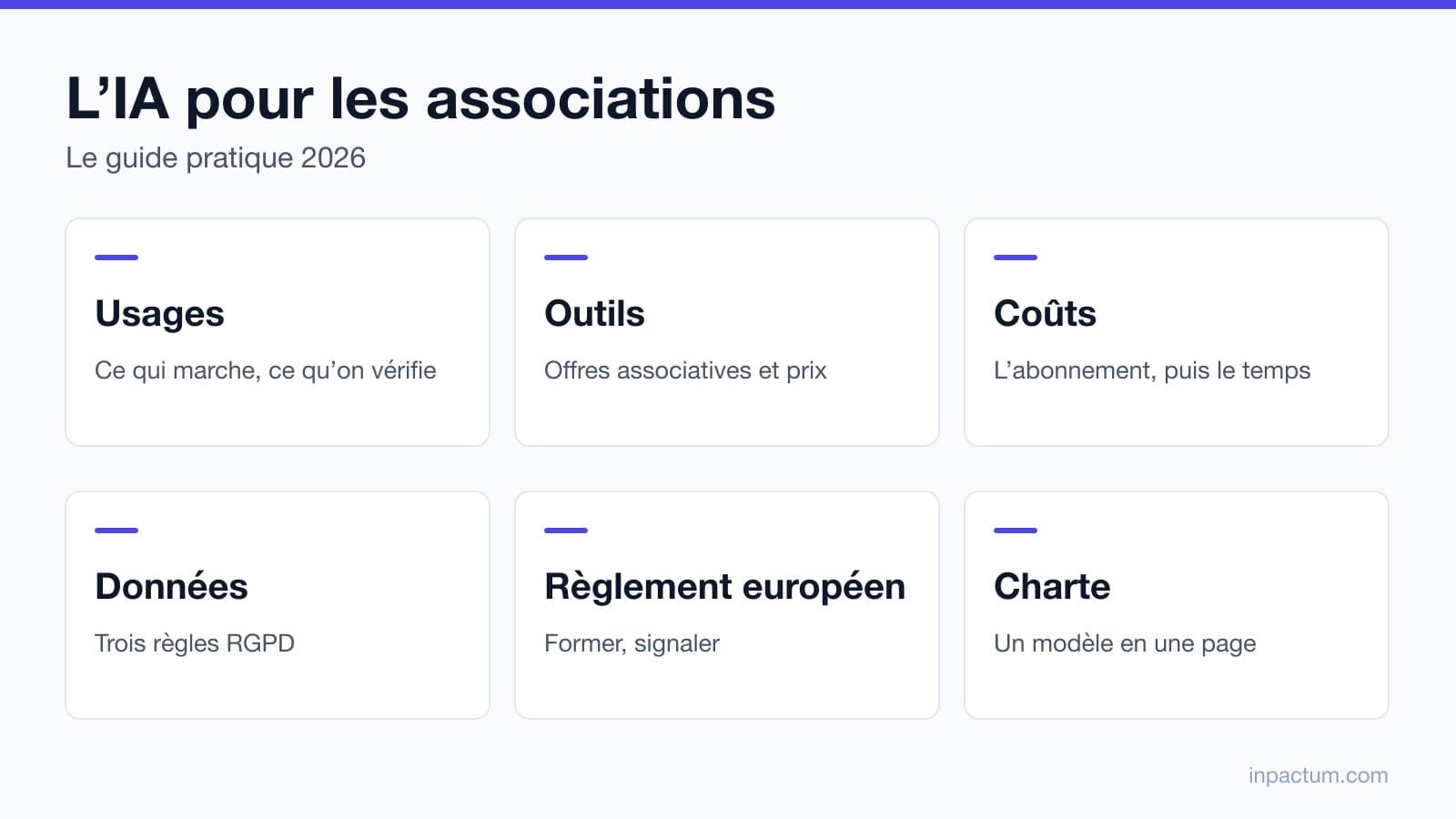
AI for non-profits: the practical guide for 2026
Uses, tools and non-profit pricing, personal data, the EU AI Act, a usage policy and support: what a non-profit needs to know to use AI in 2026.
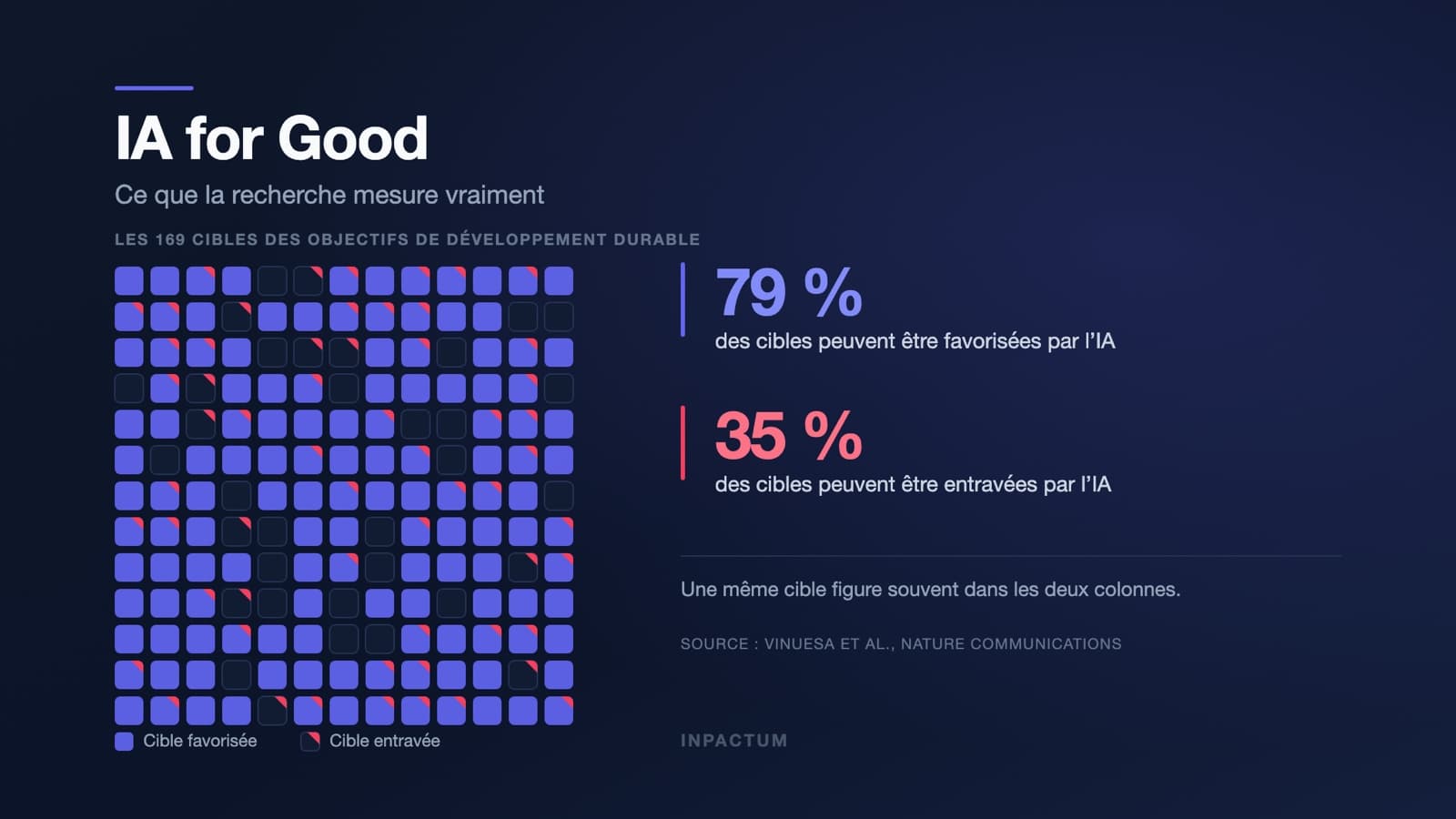
AI for Good: what the term really covers
AI for Good: where the term comes from, what research measures (79% of SDG targets advanced, 35% hindered) and 4 questions to assess a project.
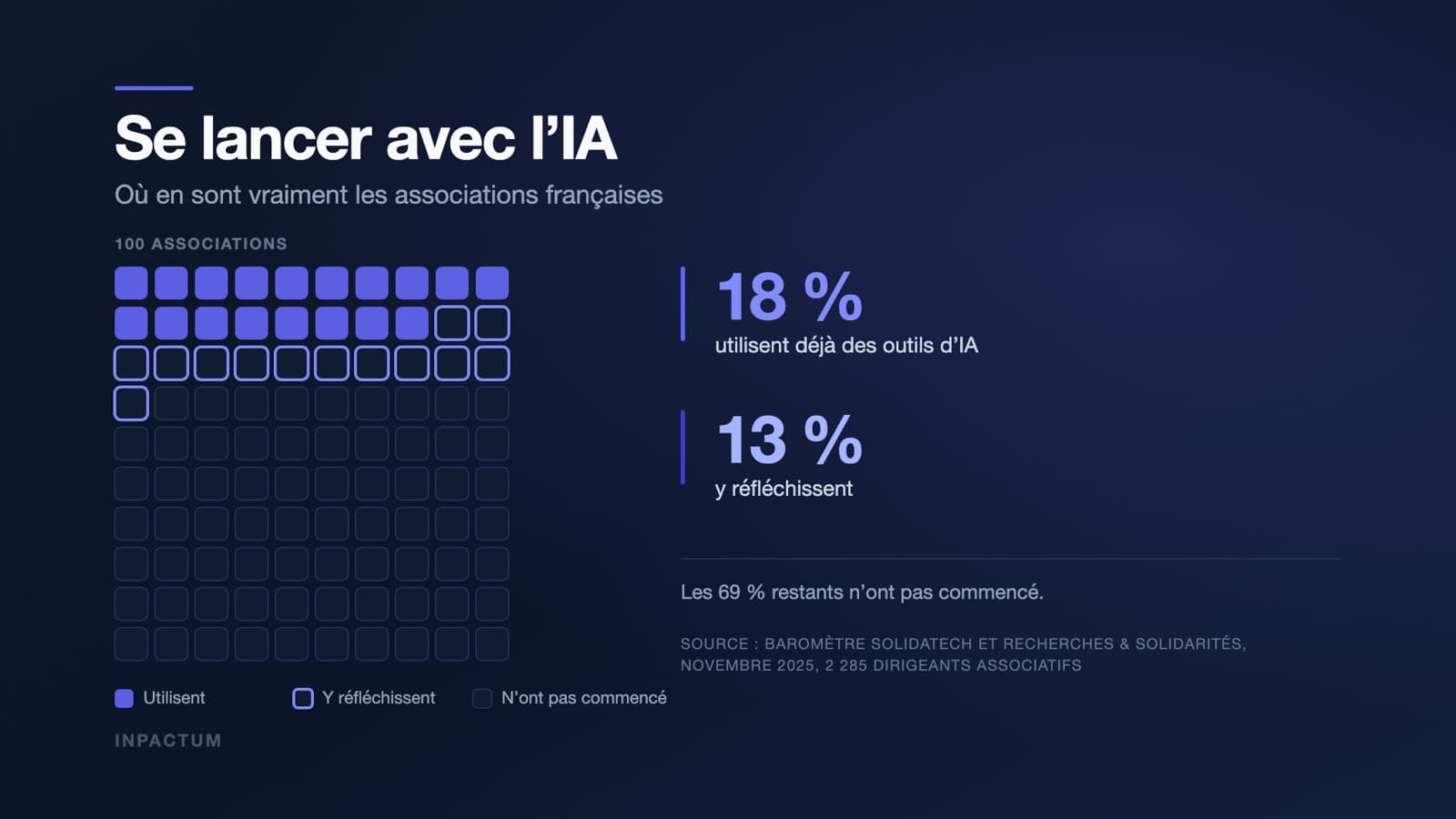
Getting started with AI as an impact-driven organisation
Where to begin, what budget, which data never to share and when to stop: a step-by-step method drawn from documented non-profit experiences.