AI for Good: what the term really covers
Alexandre Talon
Inpactum editorial team
7 min read
The phrase is everywhere: in calls for projects, company brochures, job titles. "AI for Good", or AI serving the common good. It sounds like a given, which should already raise suspicion. A concept that no one disputes is generally a concept that no one has defined.
Yet there is a precise origin, a solid body of research and a series of well-argued critiques. Distinguishing between the three helps clarify what we mean when we use the term, and above all what we commit to demonstrating.
An expression born in Geneva
"AI for Good" is first and foremost a programme. The International Telecommunication Union (ITU), the United Nations agency responsible for digital technologies, launched it in 2017 with an inaugural summit in Geneva. The stated objective can be summed up in one sentence: to identify concrete applications of artificial intelligence to advance the 17 Sustainable Development Goals (SDGs) by 2030.
The format has grown. The platform is now co-led by around 40 UN agencies and Switzerland, and claims over 37,000 contributors from more than 180 countries. The 2025 edition brought together over 11,000 participants from 169 countries, including ministers from 100 states, more than half of which were developing countries. The seventh edition was held from 7 to 10 July 2026 at Geneva’s Palexpo, focusing on sovereign AI strategies, international standards and applications in health, education, food security and disaster risk reduction. It followed by two days the first UN Global Dialogue on AI Governance.
The programme has produced tangible results in standardisation: ITU-T standards on machine learning in 5G networks, a joint framework with the World Health Organization on AI in health, and working groups on autonomous driving and disaster management.
Three meanings under one label
The term has since outgrown its original framework and now refers to three distinct realities.
The institutional programme of the UN, described above, with its summits and standardisation work.
Corporate programmes, which have adopted the term as is: AI for Good Lab at Microsoft, AI for Social Good at Google, equivalent initiatives at Nvidia and elsewhere. These programmes fund real projects and publish real results. They also serve a communications function, and the two dimensions coexist without being distinguished.
The research field, finally, which adopts a more demanding definition: addressing an unresolved societal problem using AI methods, with a measurable effect. The key word is "measurable". It is what separates a project from a press release.
What research says about real-world effects
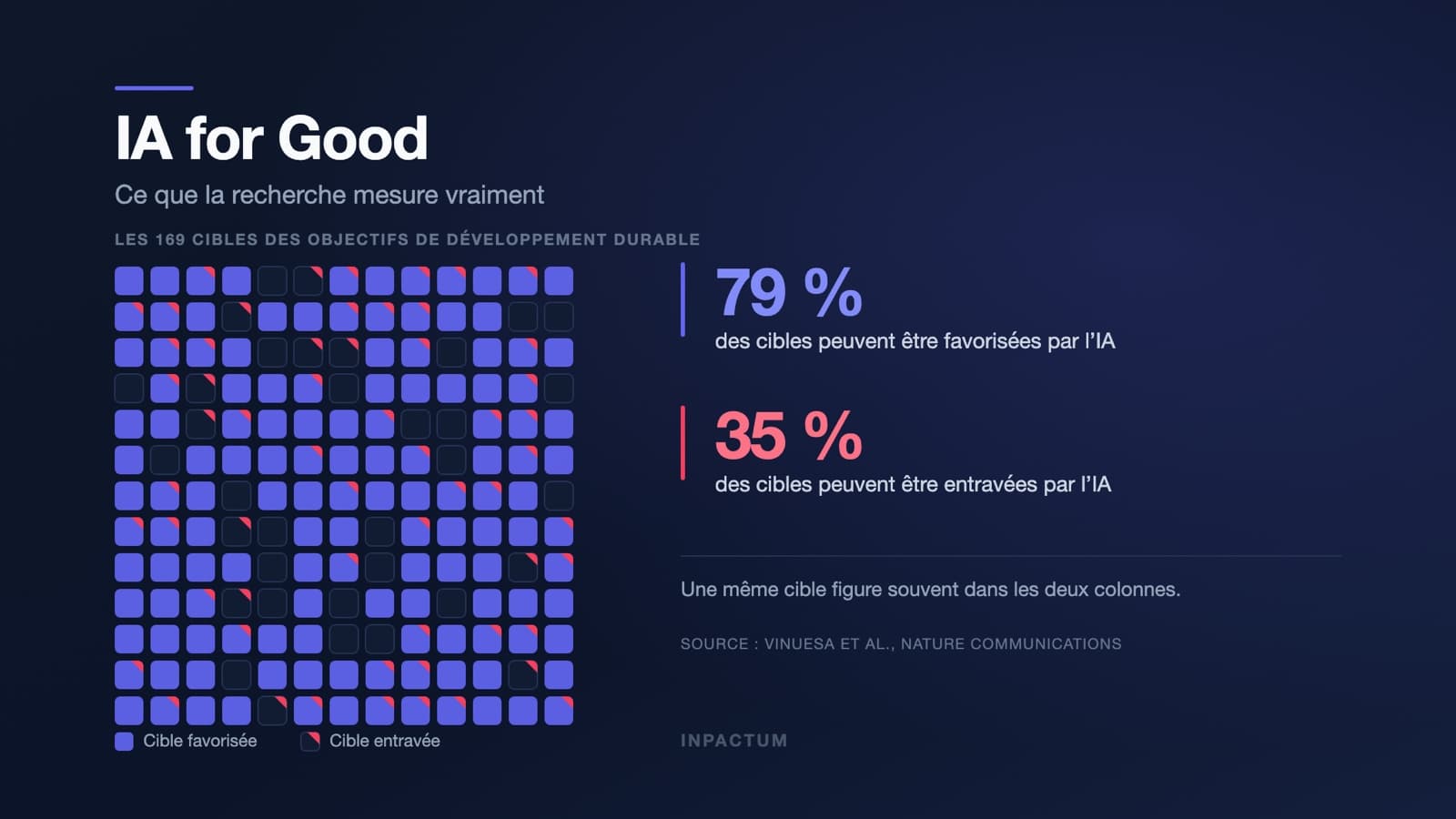
The reference study remains that of Vinuesa and co-authors, published in Nature Communications in 2020. A multidisciplinary team of academics reviewed all 169 SDG targets to assess, target by target, whether AI could advance or hinder them.
The result is twofold, and that is the study’s main value. AI can advance 134 targets, or 79% of the total. It can also hinder 59, or 35%. The two figures overlap: the same technology often appears in both columns.
The breakdown by pillar is even more telling. For environmental targets, 93% can potentially be advanced. For social targets, 82% can be, but 38% are also at risk. For economic targets, 70% versus 33%.
The authors accompany these figures with three warnings. Most AI applications target problems specific to wealthy countries, creating a net risk of worsening global inequalities. Training datasets perpetuate existing biases. And gaps in transparency, security and ethical standards call for regulatory frameworks that did not exist at the time of publication.
The critiques you need to know
The first substantive critique came early. In 2018, researcher Bettina Berendt analysed 99 contributions presented at "AI for Good" conferences and found that four basic questions were rarely addressed: what exactly is the problem, who has the power to define it, what role does knowledge play in solving it, and what are the unanticipated side effects? She proposed a method she calls "ethics pen-testing", a transposition of penetration testing: deliberately attacking the ethical design of a system to find flaws before deployment.
The second critique concerns representation. At the 2025 summit, researcher Abeba Birhane noted that 45% of the main stage speakers came from industry, with academia and civil society remaining largely in the minority. She also reported being asked to modify her presentation. Researcher Payal Arora, for her part, criticises the initiative for its paternalistic stance towards Global South countries, where problems are defined elsewhere than where they occur.
The third critique targets the gap between discourse and decisions. "Ethics washing" describes the moment when ethics becomes a reputational asset rather than an enforceable constraint: pages of values and charters of principles on one side, product roadmaps, release cycles and partnership priorities on the other, with the former having no bearing on the latter. The warning signs are fairly consistent: promises of transformation without hard data, no explanation of the technical mechanism, announced automation that in reality relies on massive human supervision, and "for the common good" messages that coexist with a contradictory business model.
Then there is the question that the common good vocabulary most often sidesteps: energy cost. According to the International Energy Agency, global electricity consumption by data centres is expected to rise from around 415 TWh in 2024 to around 945 TWh in 2030. Demand surged by 17% in 2025 alone, and even faster for AI-dedicated centres. A project that serves SDG 13 on climate action while relying on energy-intensive infrastructure must account for its net impact, not just its intent.
An example that holds up
None of the above critiques disqualify the approach; they set the bar higher. Some projects clear it.
Google Flood Hub predicts floods up to seven days in advance using public data. Coverage was extended in 2024 to all of Africa and South America, regions where increased rainfall and rapid urbanisation are heightening exposure. The models have brought forecast reliability in these regions to a level comparable to that available in Europe. Access is free, with no subscription and no requirement to be a government agency.
This case ticks the boxes Berendt demanded: a problem defined where it occurs, an identifiable beneficiary, a measurable result, and no access barriers. One may debate the actor’s motivations, but not the utility of the system.
Four questions before applying the label
For an impact-driven organisation considering an AI project, or evaluating one from a partner, these four questions are usually enough to decide.
Who defined the problem? If the answer is "the technical team" or "the funder", the project addresses available capacity rather than an expressed need. The people affected must have participated in framing the problem, not just in testing the solution.
What is being measured, and against what? A usage metric says nothing about impact. You need a baseline, an outcome variable and an order of magnitude. Without a point of comparison, there is no impact—only activity.
Who pays for the side effects? Energy consumption, dependence on a single provider, personal data collected, jobs transformed. Costs are rarely borne by those who reap the benefits, and the gap between the two is the crux of the analysis.
What happens if the model is wrong? A mistake in a content recommendation is not the same as a mistake in a medical diagnosis or access to a right. The higher the stakes, the more human oversight must be documented, not just mentioned.
What to take away
"AI for Good" is not a category of technologies; it is a claim. It refers to a real UN programme, variable corporate initiatives and a research field that, for its part, demands evidence.
For an impact-driven organisation, the value of the concept is not in claiming it. It is in using it as a framework: research identifies as many risks as opportunities across the 169 SDG targets, and nothing in the technology determines which side a given project will fall on. That is decided in the framing, in the choice of who defines the problem and what we agree to measure.
Sources
- AI for Good, ITU
- Artificial intelligence for good, ITU Media Centre
- ITU press release on the 2026 AI for Good Global Summit
- ITU AI for Good, Wikipedia
- Vinuesa et al., « The role of artificial intelligence in achieving the Sustainable Development Goals », Nature Communications
- Bettina Berendt, « AI for the Common Good?! Pitfalls, challenges, and Ethics Pen-Testing »
- « What does it mean to be good? The normative and metaethical problem with AI for good », AI and Ethics
- « AI For Good: What Does It Mean Today? », Forbes
- Google Research, « Using AI to expand global access to reliable flood forecasts »
- International Energy Agency, electricity consumption of data centres
Topics
- Intelligence artificielle
Read next
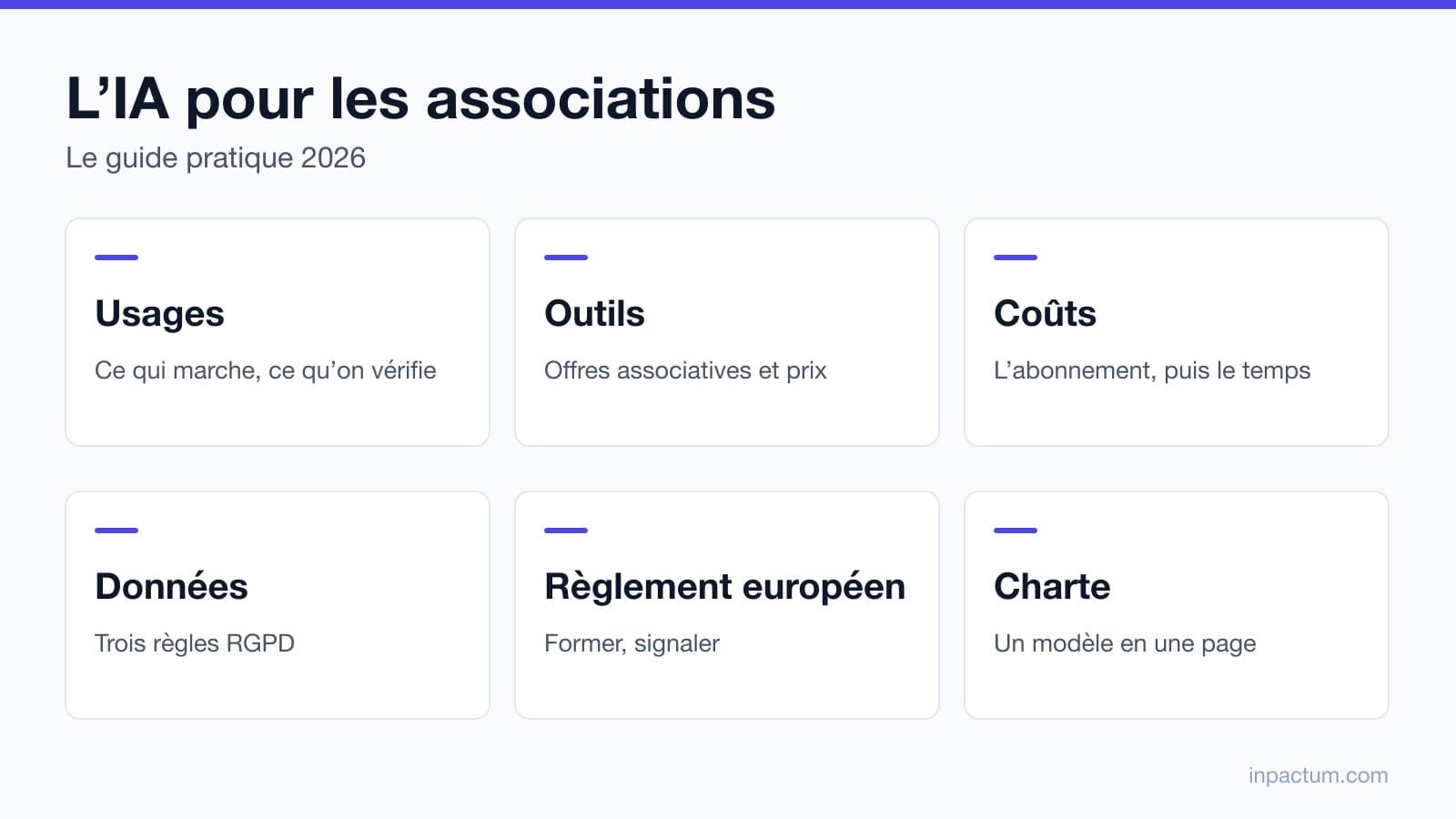
AI for non-profits: the practical guide for 2026
Uses, tools and non-profit pricing, personal data, the EU AI Act, a usage policy and support: what a non-profit needs to know to use AI in 2026.
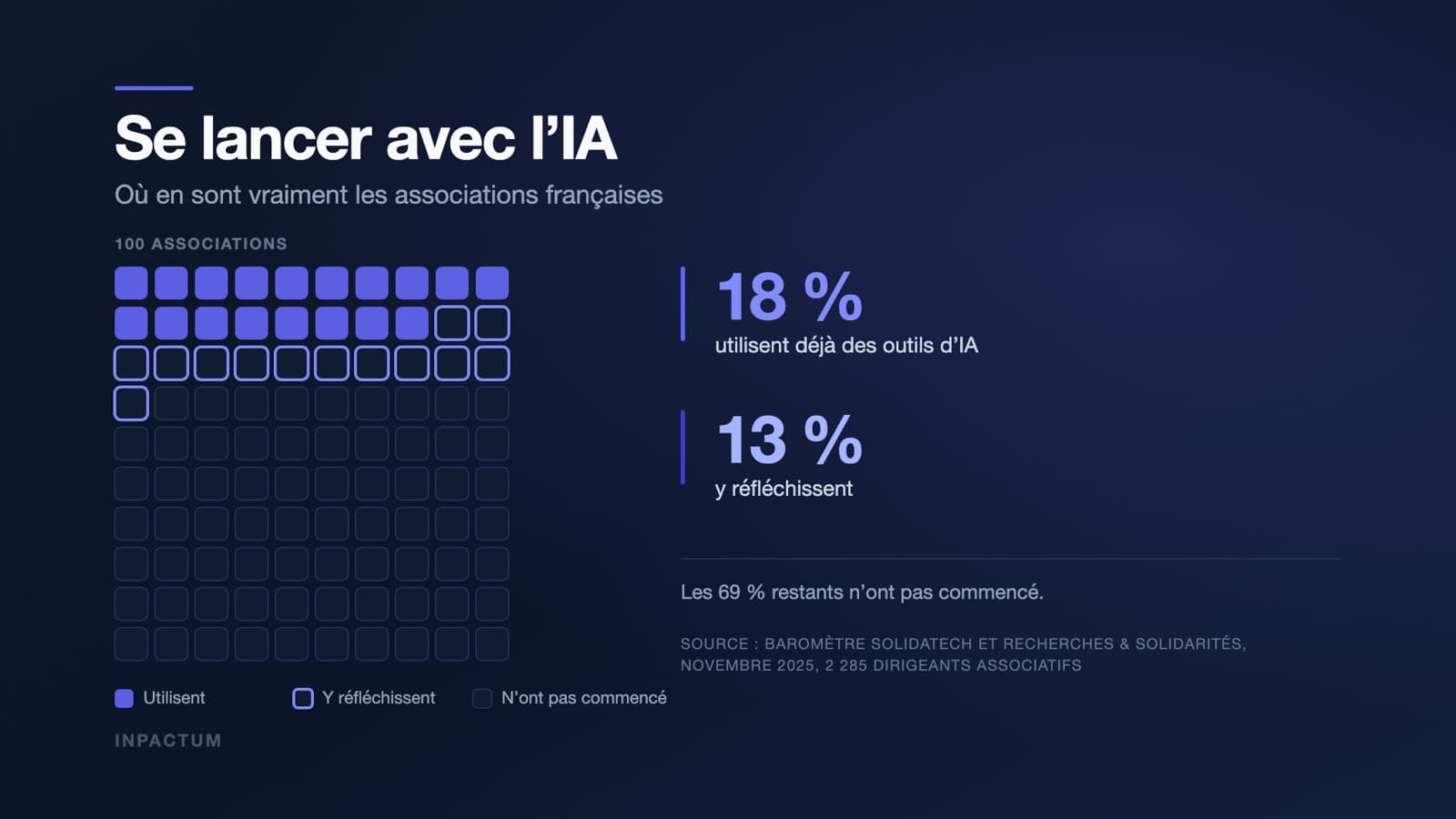
Getting started with AI as an impact-driven organisation
Where to begin, what budget, which data never to share and when to stop: a step-by-step method drawn from documented non-profit experiences.
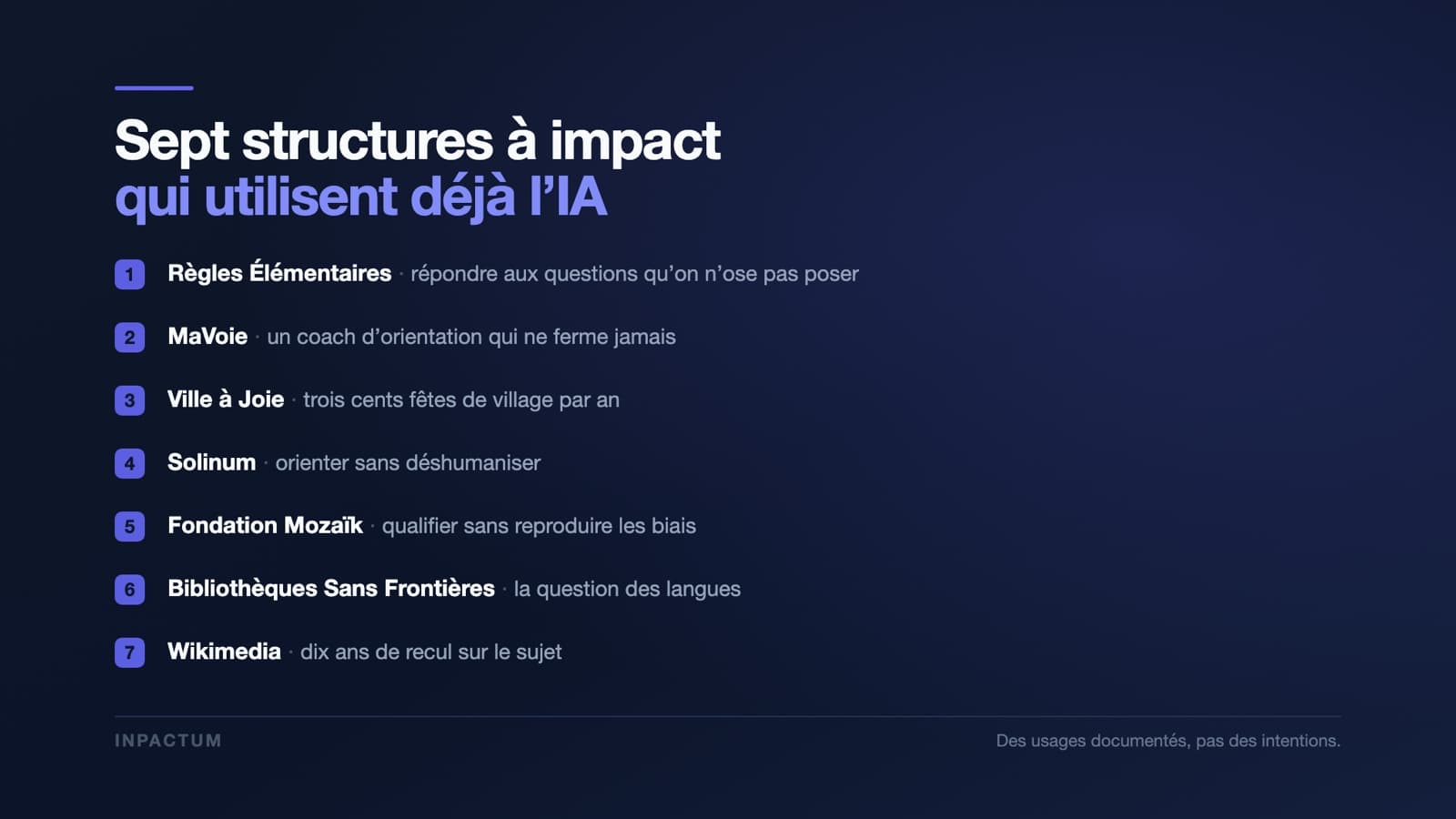
Seven impact-driven organisations already using AI
Règles Élémentaires, MaVoie, Solinum, Mozaïk, BSF, Wikimedia: seven documented uses of AI in impact-driven organisations, and what they teach.